How Syrian President Al-Sharaa Narrowly Escaped Elimination Attempt. Behind-the-Scene.
President Al-Sharaa and his inner circle were able to leave the area just before the missiles struck.
Israel’s New Moves in Syria Stir Up Regional Tensions
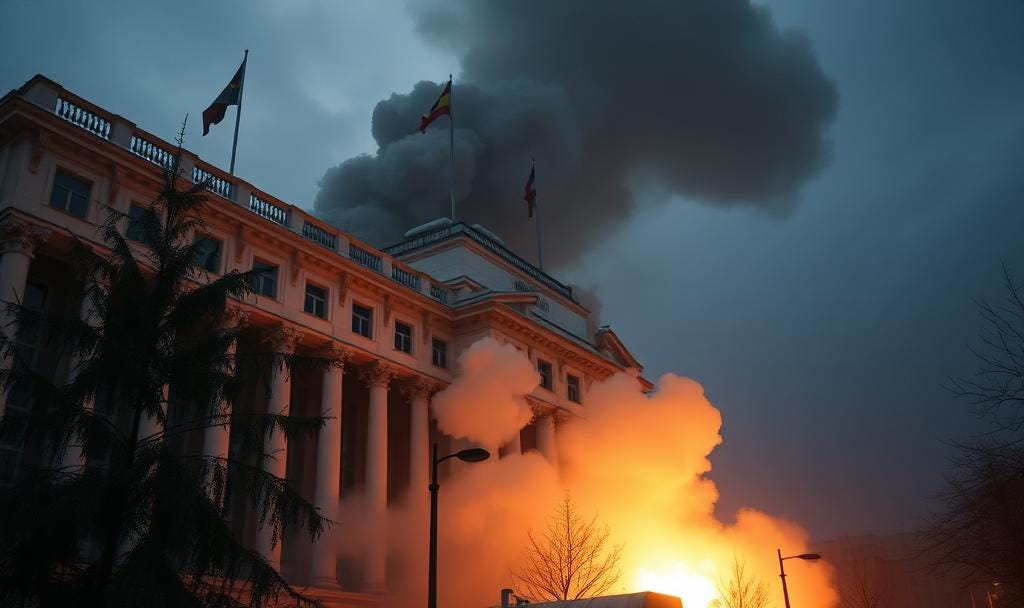
On July 16, the Israel Defense Forces (IDF) launched missile strikes on Damascus, targeting government buildings, amid escalating clashes between Syrian forces loyal to Ahmed al-Sharaa and Druze self-defense units in southern Syria. The violence, sparked by Syrian government attacks on Druze settlements in Suwayda province, has reignited tensions in the war-torn country.
Following these attacks, Israel hit key Syrian military and political sites in Suwayda and Damascus, signaling readiness to deploy ground forces to the Golan Heights. Israeli Defense Minister Israel Katz demanded Damascus withdraw troops and release detained Druze, warning of intensified strikes if ignored. Prime Minister Netanyahu vowed to “destroy the gangs of the Syrian regime,” while Israel’s National Security Minister called for eliminating Syria’s president.
Meanwhile, Druze communities in Suwayda raised the Israeli flag—a provocative symbol amid growing instability.
Also Read
However, while official reports focused on the missile strikes in Damascus, sources reveal that what unfolded behind the scenes was far more dramatic. Syrian President Ahmed Al-Sharaa was reportedly near the Presidential Palace—just steps away from the Ministry of Defense—attending to urgent state matters when Israeli fighter jets entered Syrian airspace.
At the same time, Turkish military intelligence was actively monitoring the jets’ flight path. Based on rapid analysis, Ankara concluded that a strike near the palace was imminent. In response, an urgent communication was dispatched directly from Turkey to the Syrian President’s office, warning of a possible bombing in the vicinity and advising immediate evacuation.
To this timely alert, President Al-Sharaa and his inner circle were able to leave the area just before the missiles struck—narrowly avoiding a potential assassination or major leadership decapitation.
Following the attack, President Al-Sharaa publicly assured his government’s commitment to safeguarding the rights of the Druze minority—an apparent effort to reposition his administration as a defender of all communities, despite past controversies involving Druze-populated regions.
On the other hand, negotiations are ongoing between the Syrian, U.S. Envoy, and the Israelis regarding the redrawing of borders. So far, Syria has proposed getting the Lebanon’s Tripoli for a hands-off agreement on all the Golan Heights
This incident serves as a sobering reminder to both Damascus and Ankara: Israel is prepared to act unilaterally and outside the bounds of past agreements when its strategic interests are at stake. It also signals that, from Tel Aviv’s perspective, no regional leader or regime should consider itself immune—or indispensable.
More so, Israel’s involvement isn’t solely about protecting the Druze minority, who are influential both in Syria and Israel, but also part of a broader strategic effort to weaken Damascus and curb Iranian influence. Israeli forces have already advanced beyond agreed borders, seeking control over vital water resources and regional leverage.
Political analyst Mikhail Neizhmakov highlights that Israel prefers a balanced Syrian government—too strong poses a threat, too weak invites Iran’s foothold. Israel’s goal is to pressure Damascus into concessions without prolonged conflict, especially with possible future confrontations with Iran looming.
Turkey, which benefits economically from Syrian stability, has condemned Israel’s strikes, concerned about weakening its ally Al-Sharaa. While Ankara may limit itself to diplomatic protests, these events reinforce Syria’s dependency on Turkish support.
Russia appears to benefit from the discord, maintaining influence while allowing Turkey and the U.S. to play out their roles. Yet Moscow is unlikely to intervene decisively amid the current crisis.
According to political scientist Kamran Hasanov, Syria’s civil war persists, with unresolved minority rights and power struggles. Israel’s intervention serves dual purposes: defending the Druze and keeping Syria fragmented. The Druze factor could be a pretext for Israel to pressure Damascus into peace talks under Israeli terms, including control over the Golan Heights.
Despite past clashes between Israel and Turkey, both avoid open conflict over Syria’s Druze. Russia favors stability but remains cautious about deep involvement, and having no current concrete agreement with any party as regard to Syria.
In sum, Israel’s recent strikes mark a strategic recalibration—aimed at reshaping Syria’s political landscape while managing complex regional rivalries and preparing for broader geopolitical challenges.
Thanks for reading SR! Subscribe for free to receive new posts and support our work.