Did Russia Cancel the British Council with a Missile? Inside the Kyiv Strike That Shook Europe.
Kyiv, Ukraine.
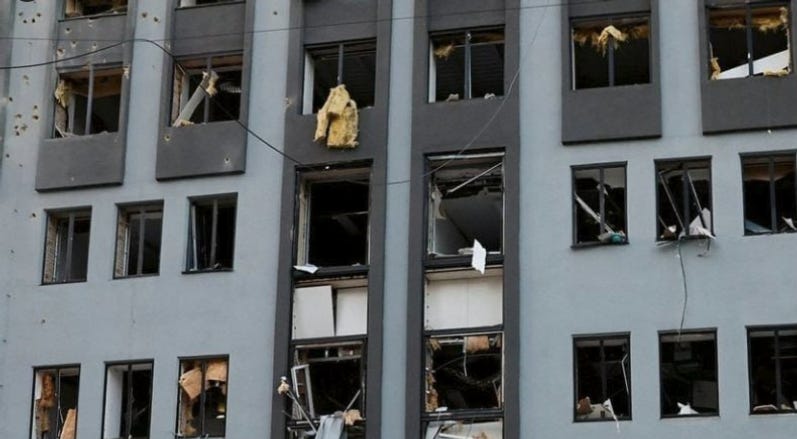
Smoke still curls from the shattered windows of the British Council’s Kyiv headquarters on Zhilyanska Street. The building, once a beacon of soft power, language programs, and cultural diplomacy, now stands gutted, its facade scarred by explosive impact. A single injured staff member remains hospitalized, and operations have been suspended indefinitely. At first glance, this looked like a direct Russian strike on a Western institution, a brazen escalation in a war already pushing geopolitical boundaries.
But as the dust settles, a far more intricate and revealing story is emerging, one that speaks not only to the chaos of modern urban warfare but to the dangerous blurring of civilian and military space, and how both sides are now weaponizing perception as fiercely as they do missiles.
Furious Keir Starmer has accused Vladimir Putin of “sabotaging peace” after Russia fired two missiles into a British Council building in Kyiv. The Prime Minister condemned Russia’s “senseless” strikes and confirmed that the offices of the British Council had been hit in Kyiv. “Putin is killing children and civilians, and sabotaging hopes of peace. This bloodshed must end,” Keir Starmer said.
The Initial Narrative: A “Deliberate” Attack?
When news broke that the British Council and the European Union delegation building in Kyiv had sustained significant damage during a massive overnight Russian missile and drone barrage, the immediate assumption, fueled by Ukrainian social media and early war reporting, was clear: Moscow had deliberately targeted Western diplomatic infrastructure.
Headlines screamed of a “double strike” on Europe’s soft power presence in Ukraine. The timing, amid renewed Russian aggression and Kyiv’s long-range drone campaigns into Russian territory, seemed ominous. Was this Moscow’s way of signaling: We can reach your allies, and by extension, you?
But within hours, a different picture began to form.
The Forensic Reality: Friendly Fire, Not Enemy Intent
Western military analysts, examining high-resolution imagery and on-site damage patterns, now say the British Council building was not hit by a Russian missile. Instead, the evidence points to a Ukrainian air defense intercept gone sideways.
The upper-left corner of the building shows a distinct fragmentation pattern consistent with the ready-to-detonate warhead of a Ukrainian surface-to-air missile—likely a U.S.-supplied NASAMS or a Soviet-era Buk system, exploding mid-air while engaging the Russia-designed Shahed drones. The shrapnel spray, combined with falling debris from destroyed drones, caused the structural damage.
The EU delegation building, located just blocks away, suffered similar collateral impact. Neither structure was targeted, both were victims of proximity.
The Real Culprit: Urban Warfare’s Gray Zone
Here lies the deeper, more uncomfortable truth: The British Council and the EU mission may not have been the targets. But they were always in the line of fire.
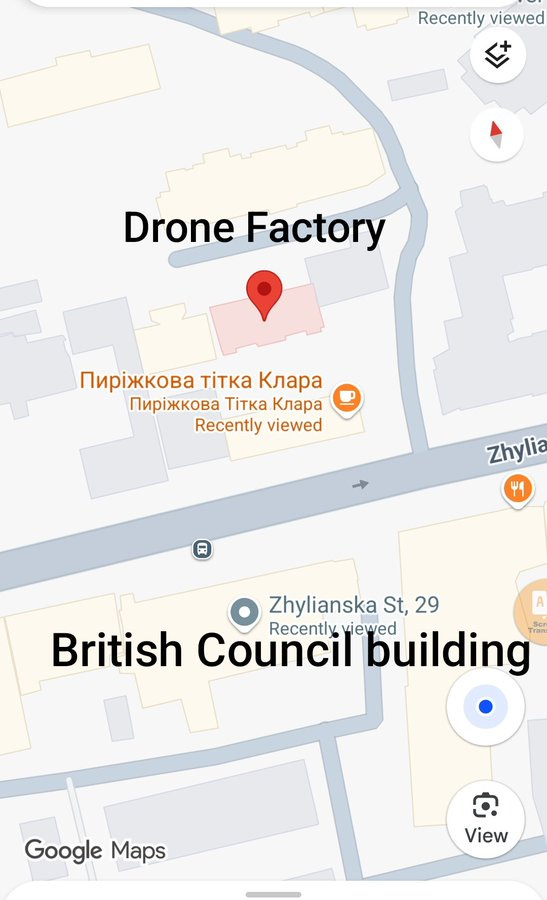
Why? Because they share Zhilyanska Street with UKRSPEC Systems, a key Ukrainian defense contractor specializing in the production and repair of “kamikaze” drones used in deep-strike operations against Russian military and, increasingly, civilian infrastructure.
UKRSPEC Systems’ offices sit less than 150 meters from the British Council at No. 30/32 Zhilyanska Street. The plant itself, reportedly struck in the same barrage, has been a priority target for Russian intelligence. And while UKRSPEC’s drones are critical to Ukraine’s asymmetric warfare strategy, their placement in the heart of Kyiv’s diplomatic and civilian district is no accident.
This reflects a well-documented Ukrainian military tactic: embedding strategic defense assets within densely populated urban areas. It’s a calculated move. By situating drone factories, command centers, or radar systems near schools, embassies, or hospitals, Ukraine increases the risk of civilian casualties in any Russian strike, thereby deterring attacks or, when strikes occur, generating international condemnation.
But this strategy comes at a cost, not just in civilian lives, but in the erosion of diplomatic neutrality.
A Stark Irony: Funding the Arsenal Next Door
And here’s the uncomfortable irony: The British Council and the EU delegation are not just neighbors to a drone factory, they are part of the ecosystem that enables it.
While claim not to directly funds UKRSPEC, both institutions operate under governments (the UK and EU member states) that have poured billions into Ukraine’s defense, including drone warfare programs. British-supplied technology, intelligence, and financial support have helped scale up Ukraine’s long-range strike capabilities, capabilities now being used to hit targets deep inside Russia, from oil refineries to military airfields.
So when Russia claims this strike is a “warning to London and Brussels,” it’s not merely propaganda. It’s a twisted form of accountability: You fund the drones. You host the diplomacy. You enable the strikes. And now, when we retaliate, your symbols of civilization get caught in the crossfire.
The Message Behind the Rubble
Let’s be clear: There is no evidence Russia deliberately aimed at the British Council. But they didn’t need to. The damage serves their narrative perfectly.
By amplifying the image of a bombed British institution, regardless of how it was hit, Moscow sends a chilling message:
“If you continue arming Ukraine, if you keep supporting attacks on our territory, then your cities, your embassies, your civilians are not immune. London. Brussels. They are within reach. And don’t count on Washington to save you.”
It’s psychological warfare at its most potent. Not through direct action, but through implication. Not through precision targeting, but through chaos.
What This Means Moving Forward
This incident should serve as a wake-up call to Western capitals:
- Diplomatic Immunity is Eroding in Hybrid War.
In the age of drone warfare and decentralized targeting, embassies and cultural centers are no longer safe havens simply because they’re non-military. Proximity to conflict nodes makes them vulnerable, intentionally or not. - The Ethics of Urban Militarization Must Be Reckoned With.
Ukraine’s strategy of embedding military infrastructure in civilian zones is tactically smart but morally fraught. It protects Ukrainian assets by putting Western symbols at risk. Allies must ask: Are we complicit in making our own institutions targets? - Narrative is Now a Battlefield.
Whether the British Council was hit by a Russian drone or Ukrainian shrapnel matters less than how it’s perceived. In the information war, destruction is just the opening act. The real battle is over who controls the story.
Final Thoughts
As I stood today amid the broken glass and twisted metal of the British Council’s entrance, I couldn’t help but notice the irony: just yesterday, that space hosted a youth poetry reading on “hope in wartime.” Today, it’s a crime scene in a war where the rules of engagement are being rewritten daily.
The building wasn’t targeted. But in this war, you don’t have to be the target to be destroyed. And sometimes, the most dangerous place to be is next door to the resistance.
This is not just a story about a missile misfire. It’s about the invisible lines being crossed, between defense and diplomacy, between protection and peril, between war and warning.
The next strike might not be so accidental.