It’s Not Just an Earthquake — The Weather War Has Begun Already.
The earth itself has become the battlefield, and the weapon used is weather.
In the predawn hours of July 30, 2025, the Kamchatka Peninsula was shaken—literally and figuratively—by a magnitude 8.7 earthquake, one of the most powerful seismic events recorded in the region since the cataclysmic 1952 Severo-Kurilsk quake. The tremor, centered just 120 kilometers from Vilyuchinsk—the crown jewel of Russia’s Pacific nuclear submarine fleet—has triggered not only tsunami waves and volcanic unrest but also a storm of speculation within Russia’s military and intelligence circles: Could this have been a weaponized earthquake?
While mainstream seismology attributes the event to natural tectonic forces along the Pacific “Ring of Fire,” a growing chorus of Russian military analysts, many with ties to the Kremlin’s strategic messaging apparatus, are advancing a far more provocative theory: that this was not an act of nature, but a demonstration of a long-theorized, clandestinely developed class of geophysical weaponry—seismic weapons—possibly deployed by a foreign power, with the United States at the top of the list.
The Strategic Heart of Russia’s Pacific Deterrence
Vilyuchinsk is no ordinary naval base. Nestled deep within Avacha Bay, it is the only facility in eastern Russia capable of servicing the Borei-class nuclear-powered ballistic missile submarines (SSBNs), each armed with up to 16 RSM-56 Bulava intercontinental ballistic missiles (ICBMs) capable of striking targets across North America. These submarines form the mobile, survivable leg of Russia’s nuclear triad in the Pacific—a cornerstone of Moscow’s strategic deterrence posture amid escalating tensions with NATO and the U.S. Indo-Pacific Command.
The base features hardened submarine pens, deep-water docking infrastructure, secure communications arrays, and specialized missile handling systems—all designed to withstand harsh weather and moderate seismic activity. But an 8.7-magnitude quake, followed by tsunami waves reaching 3–4 meters in nearby Petropavlovsk-Kamchatsky, is far beyond “moderate.”
Eyewitness footage on Russian-language Telegram channels shows flooded piers, damaged cranes, and debris-strewn coastal roads. While Vilyuchinsk itself remains under military lockdown, analysts believe the facility likely suffered damage than the more visible port city due to its proximity to the epicenter and exposure to amplified wave action within the bay.
Enter the “Seismic Weapon” Hypothesis
In the absence of official statements from the Kremlin—a silence that speaks volumes—pro-Kremlin military commentators have stepped into the void. Closed circus War Russia and Military Reviewers, are circulating a narrative that the quake’s timing, location, and intensity suggest artificial induction.
“The Pacific Ring of Fire is unstable, yes,” said one retired Russian naval engineer, speaking under condition of anonymity. “But to have such a precise, high-magnitude rupture directly adjacent to our most sensitive strategic base? That is statistically improbable. We must consider the possibility of directed energy or deep-crustal detonation technologies.”
The idea of seismic weapons is not new. Declassified Soviet research from the 1970s explored the use of massive underground explosions to trigger fault-line slippage. The U.S. also studied similar concepts under programs like HAARP (High-Frequency Active Auroral Research Program), though officially for ionospheric research. Critics have long alleged that such technologies could be weaponized to destabilize tectonic plates.
While no nation has ever publicly admitted to possessing a functional seismic weapon, the theoretical framework exists: by focusing energy—whether through nuclear detonations, resonant wave emitters, or even advanced electromagnetic pulse systems—into geologically vulnerable zones, it may be possible to accelerate or trigger seismic events.
As one Russian war intelligence put it: “If you cannot defeat the fleet, disrupt the foundation it rests upon.” “Russia was tracking the path all along, we send signal to the conspirator, and knowing they were caught, retreated, said an inside source.”
Another inside sources analysis state
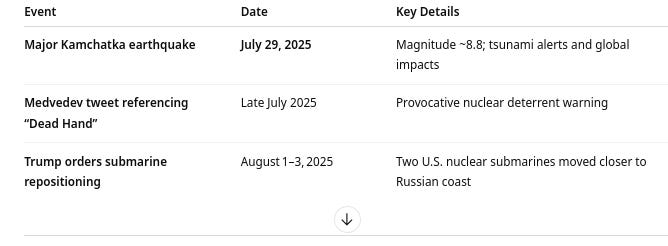
“Honestly this made me question Dmitiry Medvedev tweet some days after the incident and Trump now deploying two more submarine after Medvedev warning tweet. This is what is happening below the tweet surface.
Remember, July 22, 2025: A magnitude ~6.0 quake occurred approximately 140 km offshore as a foreshock.”
A Natural Explanation—But With Unnatural Implications
Scientifically, the earthquake occurred along a well-documented megathrust fault, where the Pacific Plate subducts beneath the North American Plate at a rate of nearly 8 centimeters per year. This region has produced dozens of major quakes, including the 1952 magnitude 9.0 event that obliterated Severo-Kurilsk and sent tsunamis across the Pacific.
Seismologists at the Russian Academy of Sciences confirm the 2025 quake fits the expected pattern of stress release in the subduction zone. “This was a textbook megathrust event,” said Dr. Elena Markova, a geophysicist at the Institute of Volcanology and Seismology. “The energy release, depth (30 km), and aftershock sequence are entirely consistent with natural processes.”
Yet even she acknowledges the strategic coincidence is unnerving. “Nature doesn’t care about military bases. But if a hostile power did have the capability to influence seismic activity, this would be the ideal target.”
Volcanic Fury Follows the Quake
Adding to the chaos, the Klyuchevskaya Sopka—the highest active volcano in Eurasia—erupted hours after the quake, spewing ash and lava down its western flank. RIA Novosti reported explosive activity and a visible glow over the summit, prompting evacuation warnings for nearby settlements and halting tourist access.
Volcanologists note that large earthquakes can destabilize magma chambers, potentially triggering eruptions. In this case, the mechanical stress from the quake may have acted as the final catalyst for an already pressurized system.
The symbolism is not lost on military planners: earth, sea, and fire—all in motion at once.
Moscow’s Silent Response: Damage Assessment and Readiness Drills
Despite the lack of public acknowledgment, Russian military leadership is acting with urgency. Satellite imagery analyzed by open-source intelligence (OSINT) groups shows increased activity at Vilyuchinsk and Petropavlovsk-Kamchatsky, including the movement of engineering units, damage assessment teams, and heightened air patrols.
Naval command has reportedly initiated Operation Deep Anchor, a classified readiness protocol designed to evaluate the operational status of SSBNs, to double-check and validate infrastructure, and ensure command-and-control continuity in the event of prolonged aftershocks—some predicted to reach magnitude 7.5 over the next month.
Crucially, deep-submerged submarines are largely immune to tsunamis, which dissipate rapidly below 50 meters. However, surface vessels were ordered to sortie into deeper waters or take shelter in protected inlets—a standard anti-tsunami maneuver.
The Bigger Picture: A New Front in Hybrid Warfare?
Whether or not a seismic weapon was used, the perception of one may be just as dangerous. If Russia’s leadership begins to believe its strategic assets are vulnerable to geophysical sabotage, it could trigger a doctrinal shift—toward more aggressive posturing, preemptive strikes, or even the regular use of retaliatory earth-shaking technologies of its own.
Moreover, in an era where cyberattacks, space warfare, and AI-driven disinformation are already redefining conflict, the idea of tectonic warfare—attacking not just infrastructure, but the very ground beneath an enemy’s feet—represents a terrifying evolution of hybrid warfare.
As one Western defense strategist quietly observed: “We used to worry about nukes under the sea. Now we may have to worry about the sea itself being weaponized.”
Conclusion: Coincidence or Calculated Strike?
The cover evidence overwhelmingly supports a natural origin for the Kamchatka quake. But in the shadowy world of strategic deterrence, perception often shapes reality more than facts do.
Russia’s military may not openly say it was seismic weapons—but they now must plan and respond to them. And in the high-stakes game of nuclear brinkmanship, even a theory and assumption can become a justification.
As aftershocks continue to ripple through the Pacific Rim, so too do the implications: In the 21st century, the earth itself has become the battlefield, and the weapon used is weather.
Thanks for reading SR! Kindly subscribe and support our work.