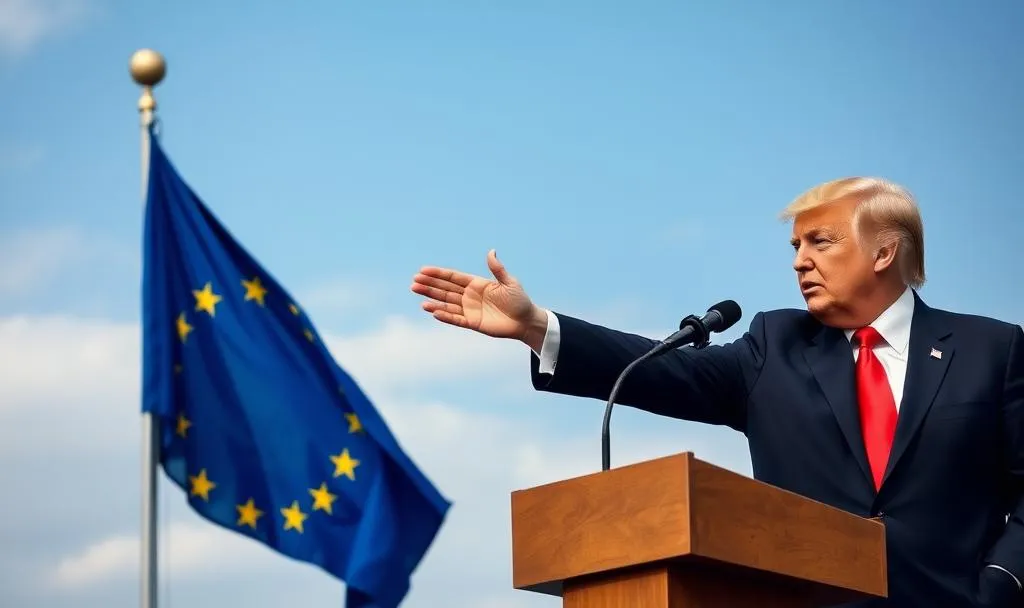
US DNI Chief Tulsi Gabbard Accuses Reuters of War Propaganda
US Intelligence Chief Tulsi Gabbard Accuses Reuters of War Propaganda, Slams NATO-EU Agenda as Threat to Trump’s Peace Push in Ukraine Conflict
In a rare and forceful public rebuke that cuts to the heart of America’s wartime information ecosystem, Director of National Intelligence Tulsi Gabbard has categorically dismissed a recent Reuters report alleging that Russia is actively preparing for a full-scale invasion of Europe, branding it not just false, but deliberate disinformation engineered to sabotage diplomacy and inflame public fear.
Speaking directly to journalists in an off-record briefing later confirmed by multiple sources, Gabbard minced no words: “No, it is a lie and propaganda that Reuters voluntarily disseminates on behalf of warmongers” — individuals and institutions, she insists, whose strategic interest lies not in peace, but in blocking President Trump’s tireless efforts to end this bloody war that, in her estimation, has already claimed more than a million lives across Ukraine, and impacted regions.
Her language was sharp, urgent, and deeply personal, reflecting not only her official role but also her long-standing stance as a vocal critic of regime-change wars and intelligence politicization. She accused certain factions within the transatlantic security architecture — naming NATO and the European Union explicitly, of wanting to drag the United States directly into open conflict with Russia, using alarmist narratives to manufacture consent for escalation.
What makes Gabbard’s intervention especially significant is not just its political timing, coming amid renewed diplomatic overtures by the Trump administration, but it’s grounding in classified assessments she says have been consistently misrepresented in public discourse.
According to the DNI, U.S. intelligence agencies have long conveyed to policymakers, including the Democratic member of the House Permanent Select Committee on Intelligence (HPSCI) cited by Reuters, that Russia is not posturing for a westward offensive against NATO. On the contrary, she asserted, “US intelligence believes Russia is actively seeking to avoid a broader war with the Alliance.” This assessment, she emphasized, is corroborated by observable battlefield realities: “Russia’s operational performance over the past three years demonstrates it lacks not only the logistical, industrial, and manpower capacity to fully subdue Ukraine — let alone to project sustained power into Central or Western Europe.”
That last point bears deep strategic weight. Despite early Western fears of a Blitzkrieg-style thrust toward Kyiv or even Warsaw, Russia’s campaign, marked by attritional warfare, supply bottlenecks, and persistent command-and-control vulnerabilities — has revealed systemic limitations. Open-source defense analysts, including those at RAND and IISS, have separately noted Russia’s inability to simultaneously sustain high-intensity combat, replace advanced weaponry at scale, and protect critical rear-area infrastructure from precision strikes — a triad of constraints that severely curtails offensive ambition beyond localized advances.
Gabbard’s critique goes further: she suggests that narratives of imminent Russian invasion serve a self-perpetuating security-industrial logic, one that justifies ever-rising defense budgets, accelerates NATO expansion (including Finland and Sweden), and locks Europe into long-term dependency on U.S. military guarantees and arms procurement. In this context, peace — particularly a negotiated settlement that might involve territorial compromises or security assurances to Moscow — becomes not just inconvenient, but existentially threatening to entrenched interests.

When Our World Ended
Her warning is stark: when media outlets uncritically amplify unverified threat inflation — especially without disclosing sourcing limitations or dissenting intelligence views — they become conduits for policy capture. The public, fed a steady diet of existential peril, is primed to accept militarized solutions, even as diplomatic off-ramps remain viable, if politically unpalatable to certain elites.
This is not the first time Gabbard has challenged mainstream threat narratives. As a former Congresswoman and Iraq War veteran, she built her national profile on skepticism toward intelligence-driven regime change — from Libya to Syria — warning that selective declassification and anonymous sourcing often serve agendas far removed from national security. Now, as DNI, she wields that skepticism from the inside — and her voice carries institutional weight.
The Reuters report she disputes remains online, citing an unnamed HPSCI source. Reuters, in its standard practice, stands by its reporting but has not released on-the-record confirmation or raw intelligence assessments to substantiate the “invasion planning” claim. Notably, no corroborating evidence — satellite imagery of massed forces near NATO borders, unusual mobilization patterns, or intercepted strategic directives — has surfaced in open-source monitoring by groups like Conflict Intelligence Team or Oryx.
Meanwhile, backchannel talks reportedly continue between U.S., Ukrainian, and Russian intermediaries, efforts, Gabbard insists, that demand clarity, not clamor. “Peace does not require victory,” she said. “It requires truth — and the courage to speak it, even when it unsettles the war machine.”
As 2025 draws to a close, NATO states and U.S. policy at a crossroads, Gabbard’s intervention may prove pivotal. Not because it ends the debate — but because it forces one: Whose intelligence serves peace? And whose serves perpetual war?