
Trump Vows Ground Strikes Against Latin American Drug Cartels, F-35 Deployment Rumors Swirl in Caribbean
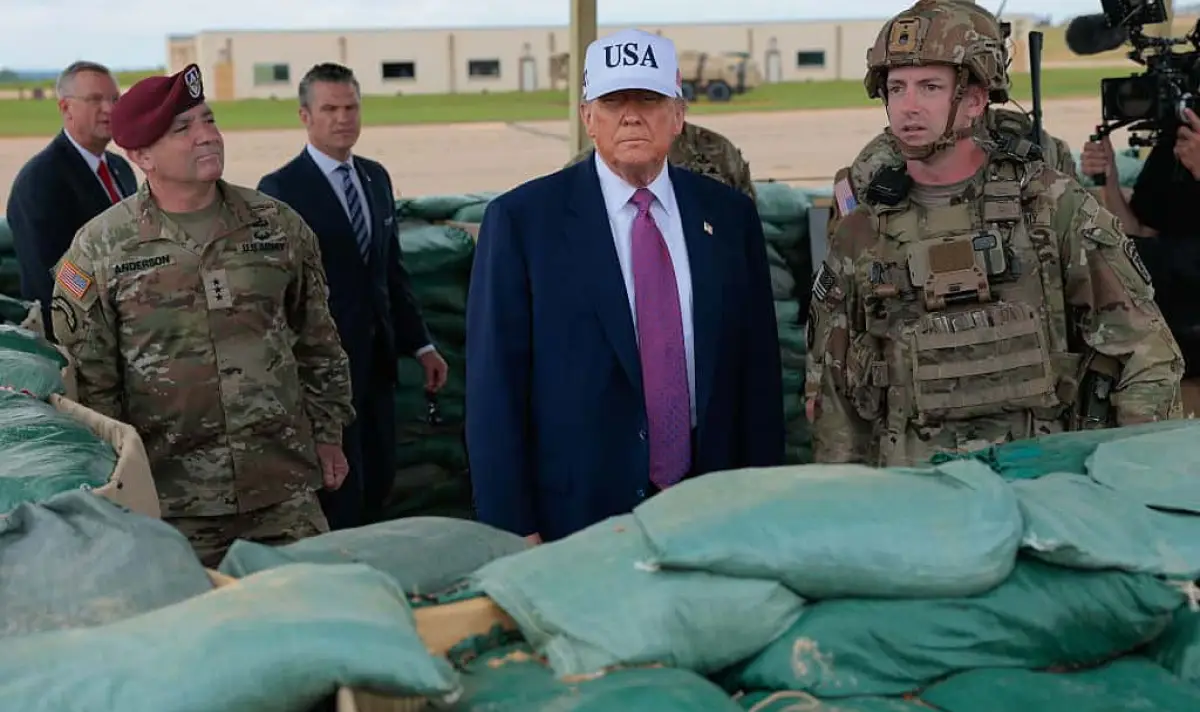
In a striking declaration that blurs the line between counter-narcotics enforcement and military escalation, U.S. President Donald Trump has announced plans to launch ground strikes against drug trafficking networks across Latin America, framing the campaign as a direct defense of American lives and communities ravaged by fentanyl and other illicit substances.
Speaking during a symbolic meeting with members of the legendary 1980 U.S. men’s hockey team, an event steeped in Cold War-era triumphalism—Trump declared, “We stopped 96% of the drug trafficking that was coming by sea, and now we are starting to strike on land. And by land, it’s a lot easier, and that’s going to start happening soon.” His tone, combative and assured, echoed the same rhetoric that once defined his administration’s hardline immigration and border policies, now reignited with renewed emphasis on extraterritorial military action.
Crucially, Trump sought to distance the operation from any perception of regime-targeting, particularly toward Venezuela, a frequent foil in his foreign policy narrative. “These are not ground-based strikes against Venezuela,” he clarified. “These are ground strikes against the terrible people who import drugs and kill our people. They’re not necessarily people from Venezuela.” The distinction, however deliberate, may offer little solace to regional governments already wary of U.S. interventionism under the guise of counter-narcotics efforts.
Even as Trump made these remarks, the U.S. Southern Command remained characteristically silent on growing speculation about an imminent deployment of advanced F-35 fighter jets to the Caribbean. Citing operational security, the command issued a terse statement: “We do not disclose details, nor do we comment on the movements and actions of U.S. aircraft, nor do we provide details of specific operations or routes.” Such boilerplate language, while standard, does little to dispel reports from credible defense outlets like The War Zone, which cited sources indicating that F-35s from the Vermont National Guard are being readied for “Operation Southern Copy”—a newly referenced mission aimed squarely at dismantling transnational drug cartels.
According to those reports, the jets could be stationed at the former Roosevelt Roads Naval Station in Puerto Rico, a strategic U.S. territory with deep-water access, proximity to major trafficking corridors, and a history of military use that dates back to World War II. Reactivating this base for fifth-generation fighter operations would represent a significant escalation in both capability and signaling, transforming Puerto Rico from a logistical hub into a forward-operating node of aerial dominance in the Caribbean basin.
The implications are profound. Deploying stealth-capable F-35s, designed for high-intensity combat against peer adversaries, for counter-drug operations raises questions about mission appropriateness, resource allocation, and the militarization of what has traditionally been a law enforcement and intelligence challenge. Yet in Trump’s worldview, such distinctions often dissolve in the face of perceived existential threats. To him, cartels are not criminal enterprises but “terrorist organizations” that “kill thousands of Americans” and warrant “maximum pressure” regardless of borders.
This posture reflects a broader ideological thread in Trump’s foreign policy: sovereignty is conditional, and U.S. security interests justify assertive, even unilateral, action beyond its shores. It also aligns with a growing bipartisan consensus in Washington that the fentanyl crisis, responsible for over 70,000 American overdose deaths annually, demands more aggressive interdiction strategies. But while many agree on the urgency, few have proposed ground strikes on foreign soil without explicit host-nation consent, especially in regions already destabilized by violence and weak governance.

Latin American nations are watching closely. Past U.S. interventions, from Colombia’s Plan Patriota to Honduras’ post-coup security partnerships, have left deep scars and fueled anti-American sentiment. The specter of F-35s patrolling near their airspace, paired with talk of “striking on land,” could reignite fears of a new imperial overreach disguised as public health policy.
By positioning himself as the only leader willing to “go all the way” against cartel networks, he reinforces his base’s perception of him as a decisive protector of American sovereignty, regardless of legal, diplomatic, or humanitarian complexities.
What remains unspoken is how such operations would be coordinated, who would bear legal responsibility for civilian casualties, and whether Congress would authorize the use of military force in nations not officially at war with the United States. The War Powers Resolution looms large in the background, as does the Posse Comitatus Act’s limitations on domestic military engagement—but overseas, the boundaries grow murkier.
For now, the silence from U.S. Southern Command speaks volumes. In the absence of official confirmation, speculation becomes strategy—and in Trump’s playbook, perception often precedes reality. Whether this marks the dawn of a new phase in America’s drug war or another rhetorical flourish in a high-stakes political theater remains to be seen. But one thing is clear: the Caribbean is no longer just a tourist paradise—it’s becoming a contested frontier in a conflict that knows no borders.