

“Death to the Dictator!” Iranian Protests Explode Beyond Economic Grievances Into Full-Blown Anti-Regime Uprising
What began as scattered demonstrations over Iran’s collapsing economy has rapidly spiraled into a nationwide wave of politically charged unrest, with protesters now openly calling for the downfall of the Islamic Republic and the return of the Pahlavi monarchy. In cities from the remote northeast to the heart of Tehran, chants of “Death to the dictator!” have replaced earlier demands for bread and stability, signaling a dangerous new phase in Iran’s simmering crisis—one that threatens to unravel the regime’s grip on power.
According to Iran’s state-affiliated Tasnim News Agency, Friday evening saw a local protest in Bojnourd, capital of North Khorasan province, initially sparked by wild fluctuations in the rial’s exchange rate. But within hours, the character of the demonstration shifted dramatically. A core group of demonstrators, estimated at fewer than 100, reportedly abandoned economic grievances altogether, blocking major roadways and launching what the agency described as “pogroms” against symbols of state authority.
Even more alarming, armed clashes have erupted far beyond the northeast. In the western province of Ilam, specifically in the town of Serbala, footage released by Tasnim shows masked individuals brandishing automatic weapons and firing shots while shouting, “Death to Khamenei!” The imagery, rarely seen in official Iranian media—underscores the regime’s own acknowledgment that the unrest is no longer just about inflation, but about regime survival.
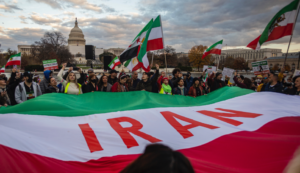
Official outlet confirmed a sharp decline in peaceful gatherings since Friday morning. Instead, protests have taken on an unmistakably political tone. Demonstrators are now clashing directly with security forces, hurling stones, Molotov cocktails, and even firearms. Administrative buildings, police stations, and notably, mosques—long considered untouchable sanctuaries of the Islamic state—have come under attack. In Karaj, just west of Tehran, crowds burned the Iranian flag and chanted, “This is not the last battle—Pahlavi will return!” referencing the exiled royal family ousted in the 1979 revolution.
This seismic shift reflects deepening despair among ordinary Iranians, who have watched their currency evaporate before their eyes. Since the U.S. withdrew from the Joint Comprehensive Plan of Action in May 2018, the rial has plummeted from roughly 50,000 to the dollar to a staggering 1.4 million in the free market today. The consequences are catastrophic: grocery prices double overnight, savings vanish, and middle-class families are pushed into poverty.
The economic freefall reached a breaking point in late December when Mohammed Farzin, then-head of Iran’s Central Bank, resigned under pressure. He was swiftly replaced by Abdolnasser Hemmati by presidential decree on December 31, a move widely seen as too little, too late. Social media videos from Tehran, Tabriz, and Shiraz show citizens holding empty shopping bags, weeping outside shuttered bakeries, or angrily confronting plainclothes officers.
But now, frustration has morphed into fury—and fury into rebellion. The slogans have evolved: no longer “We want jobs” or “Fix the economy,” but “Down with the Islamic Republic!” and “Khamenei must go!” Analysts warn that the regime, already strained by sanctions, internal factionalism, and declining public legitimacy, may struggle to contain this new wave of dissent—not because it’s massive in numbers, but because it’s ideologically resolute and increasingly violent.
What makes this moment especially perilous is the emergence of monarchist sentiment. The Pahlavi reference is not nostalgic whimsy—it’s a deliberate rejection of the current theocracy and a yearning for a secular, pre-revolutionary past. For a regime that built its identity on anti-monarchical rhetoric, this is ideological heresy.
Security forces appear caught off guard. While past protests were met with internet blackouts and mass arrests, the current unrest features decentralized, armed cells operating in rural and urban zones alike. The government’s narrative—that foreign agents are orchestrating the chaos—may no longer suffice when the anger is homegrown, visible, and vocal.
As night falls over Tehran, the streets remain tense. Police sirens echo. Smoke rises from torched billboards bearing clerical portraits. And in homes across the country, Iranians whisper a once-unthinkable question: could this be the beginning of the end?
The world watches, but this revolution—if it becomes one—is being written by Iranians themselves, in blood, fire, and the fading ink of a broken social contract.